Hostility Index Survey
Assessment Overview
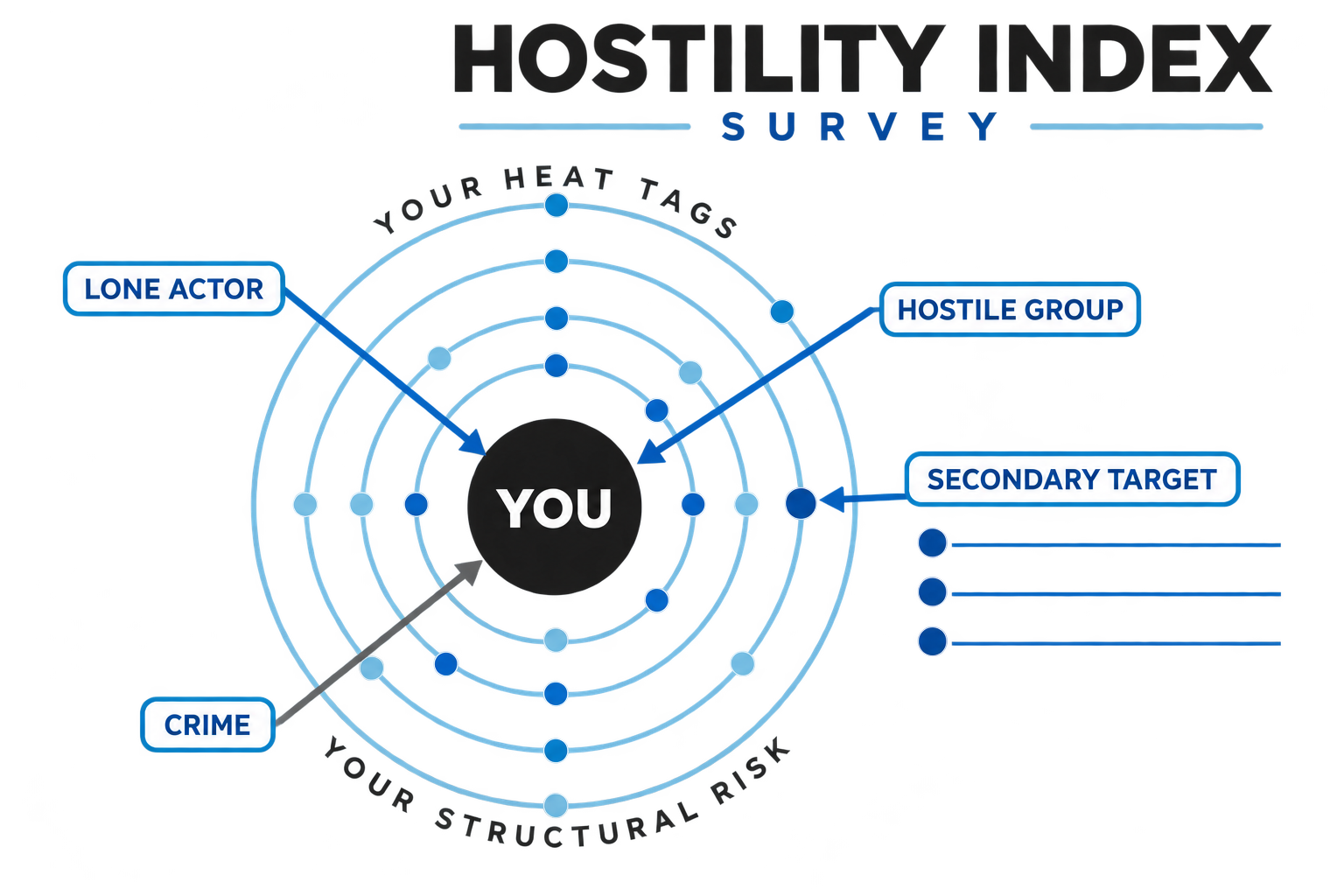
This measures structural risk: the risk you generate from being who you are. It is one part of your threat surface, and understanding it is how we decide what to protect first.
The intake produces two readings. Exposure is what makes you worth targeting. Pressure is what has already reached you. They call for different work, and your answers determine which comes first.
Nothing is scanned here. Your analyst runs the technical exposure work separately and reconciles the two at review.
⏱ 5 to 10 minutes
Before you start
- Don't minimize. The most common failure here. People downplay harassment because it stopped or seemed minor in hindsight. Under-reporting routes you to lighter protection than you need. Between two options, take the higher one.
- Answer “what you are” questions as of today. Answer “what has happened” questions across your whole history, including matters you consider closed.
- Best estimate is fine. Don't research your answers.
- Select an affiliation only if it would surface in a search for your name. Leadership, board, ownership, or spokesperson roles count. Ordinary membership doesn't.
- Answer for yourself only. Covered family members complete their own assessment and we link the records.
Section 1 of 18
Professional Visibility
Section 2 of 18
Financial & Social Presence
Section 3 of 18
Public Records & Family
Section 4 of 18
Findability & Records
How easily someone outside your household could locate or identify you
Section 5 of 18
Household & Routine
How your household and daily pattern connect to your public surface
Section 6 of 18
Community Roles
What people would associate you with beyond formal records
Section 7 of 18
Public Positions
Section 8 of 18
Unwanted Attention
What has already reached you
Section 9 of 18
Harassment & Doxxing History
Section 10 of 18
Network Targeting & Identity
Section 11 of 18
Grievance Holders & Trajectory
Section 12 of 18
Targeting Specificity
This determines whether incidents indicate a personal fixation or general-population exposure
Section 13 of 18
Heat Tags — Brands & Affiliations
Tags now route to adversary groups — not a flat score
Section 14 of 18
Heat Tags — Political & Ideological
Section 15 of 18
Heat Tags — Professional Roles
Section 16 of 18
Heat Tags — Digital & Technology
Section 17 of 18
Heat Tags — Identity & Science/Health
Section 18 of 18
Additional Context (Optional)
This helps calibrate the adversary attribution in your report

Adversary Profile
Which adversary groups are active in your profile, and how hot each one is. Solid bar = structural profile. Shaded extension = added by realized-incident evidence.
Salience & Findability
Salience and Findability are internal amplifiers, not separate scores. Salience — drawn from your professional visibility and recognition — scales the threat level of every adversary group. Findability — drawn from your records exposure and schedule predictability — scales specifically the actors who need to physically or digitally locate you: fixated individuals, militants, criminals, and foreign actors. Together they explain why two people with the same Exposure score can face very different adversary profiles.